


Ambulance transport attendant career and qualification pathway
Ambulance transport attendants monitor and care for patients during non-emergency transport, working a level above patient transport officers. You can qualify with a Diploma of Emergency Health Care, unlike paramedic roles that require a university degree. This page covers what the work involves and how to qualify.

Understand the path from certificate to career
Ambulance transport attendants rank a level above patient transport officers, taking on higher acuity patients and needing a diploma to get there. Where you start depends on whether you’re already working in patient transport or coming in from outside the industry.
What does an ambulance transport attendant do?
Ambulance transport attendants monitor and care for patients during non-emergency transport. Victorian law defines the role around low-acuity patients, though you’ll also assist other crew members with medium- and high-acuity work, which is what separates the job from patient transport.
On a shift, you’ll transport patients between hospitals, aged care facilities and appointments, assessing them before you load them and watching for changes along the way. You’ll work in a crew of two on a stretcher-equipped vehicle.
What the job involves
Non-emergency doesn’t mean uneventful. Ambulance transport attendants spend most of their shifts:
Assessing patients before and during transport
You’ll assess every patient before you load them, then monitor them the whole way. A patient who was stable when you left can get worse in the back of the vehicle, so you have to watch for that and decide whether to keep going or take them somewhere closer. That judgement is what the diploma-level qualification prepares you for.
Moving people who can’t move themselves
You’ll carry patients onto stretchers and into wheelchairs, then manoeuvre them through narrow hallways and down stairwells. You’ll do this with one other person, several times a shift, which is why this qualification covers manual handling throughout.
Getting patients to appointments on time
Dialysis and oncology appointments start at a set time, and the clinic won’t always hold the slot if you’re late. You’ll lose time to traffic, a delayed discharge or a patient who isn’t ready when you arrive.
Talking to people having a bad day
Your patients are unwell, often elderly, and frequently anxious about where they’re going. Some have dementia. Some are heading to appointments they’re frightened of. What you say in the back of the vehicle matters as much as the monitoring.


What ambulance transport attendants earn
Ambulance Victoria’s enterprise agreement sets the base rate for ambulance transport attendants at $1,323.50 a week, or roughly $68,800 a year. That’s the floor that everyone’s required to meet, though providers are free to offer more than that to attract talent.
For example, the Royal Flying Doctor Service Victoria advertises $36.25 to $41.82 an hour for metro Melbourne attendants, which works out to roughly $71,600 to $82,700 a year. You can also make more than that by working weekends and night shifts, which attract penalty rates on top of your base hourly rate.
Where the career can take you
Non-emergency patient transport has its own ladder. Once you become an ambulance transport attendant and get enough experience, you can become a clinical instructor supervising the placement hours new graduates need.
It won’t turn into a paramedic job, though. No ambulance service recruits paramedics from non-emergency transport, so the hours you log here don’t count towards registration. Your experience here does give you hours of patient contact and clinical work, which can strengthen a university application if you’re interested in pursuing a Bachelor of Paramedicine.
Where the title is used
Victoria is the only state that defines this role in law. The Non-Emergency Patient Transport Regulations 2026 set out what an ambulance transport attendant is, what qualifications the role takes and which patients you can monitor. Everywhere else, employers name the job whatever they like.
That’s why you’ll see the title in Victoria but rarely anywhere else. Ambulance Victoria recruits ambulance transport attendants regularly across Hume, Gippsland, Loddon Mallee, Grampians and Mildura. Royal Flying Doctor Service Victoria, trading as Mobile Patient Care, is the other major Victorian employer. A couple of national operators use the title interstate, though some of those roles ask for nursing or paramedic registration instead of a diploma.
How to become an ambulance transport attendant
You need a diploma-level qualification and supervised on-road experience. In Victoria, both are set out in the Non-Emergency Patient Transport Regulations, so there’s no room for an employer to waive them. This is how you become an ambulance transport attendant:
- Complete a diploma-level qualification: The Diploma of Emergency Health Care is the standard route. Registered Division 1 nurses can qualify instead by completing a bridging course for non-emergency patient transport practice, and registered paramedics already meet the bar.
- Log 400 supervised on-road hours: Victoria requires recent diploma or degree graduates to complete 400 hours of supervised clinical placement with a non-emergency patient transport provider, recorded in a logbook. Your Diploma includes 160 of those hours, so you’ll accumulate the remainder working under supervision after you graduate.
- Apply through a licensed provider: Ambulance Victoria and the private NEPT operators both recruit directly. You’ll also need a police check, a working with children check, and a full Victorian driver’s licence.
Ambulance transport attendant vs patient transport officer
Both crew the same vehicles and move the same kinds of patients but work with different scopes. This is how the roles are different:
| Ambulance transport attendant | Patient transport officer | |
|---|---|---|
| Qualification | Diploma level or nursing or paramedic registration | Certificate III in Non-Emergency Patient Transport |
| Patients | Low acuity, plus assisting with medium and high acuity | Low acuity and clinically stable |
| What you do | Assess patients, monitor them clinically and intervene within protocol | Transport clients safely and without injury |
| Pay | Higher at every employer | Lower, though it’s the more accessible entry point |
Many people become a patient transport officer first and then move up. The Certificate III in Non-Emergency Patient Transport takes eight to 24 months, which gets you working and earning while you study towards the Diploma.
Recommended courses
The Diploma is the qualification that gets you working as an ambulance transport attendant. The two certificates below take you into patient transport first, which is how many people fund their way through the Diploma.
HLT31120: Certificate III in Non-Emergency Patient Transport (NEPT)
Train for patient transport work in a structured, supportive learning model.
HLT41120: Certificate IV in Health Care
A strong foundation in emergency health care, with online learning and practical training.
HLT51020: Diploma of Emergency Health Care
Our flagship qualification for pre-hospital care is delivered online, with hands-on workshops.
A simple training sequence
You don’t have to work through every level, though the option is there if you’d like to start from a Certificate II and work your way up. Plenty of people enrol straight into the Diploma if they meet the entry requirements:
Start here if healthcare is new to you. You’ll cover emergency care basics and how to work safely around patients.

Take this to work as a patient transport officer, which is the most direct way into the industry.
Choose this for stronger clinical decision-making before the Diploma. It also opens up event medical work and site medic roles you can pick up while you study.
This is the qualification ambulance transport attendant roles require.
Do you need a degree?
No. A diploma-level qualification gets you there, which is what separates this role from paramedic work. The Diploma of Emergency Health Care takes eight to 24 months to complete and you can study it while already working in patient transport.
First aid and CPR courses
You’ll need first aid certification before you can start several units in the Diploma. Booking one early also tells you whether hands-on patient work suits you before you commit to a longer qualification.
HLTAID009: Provide Cardiopulmonary Resuscitation
Nationally recognised CPR training. Essential skills for the workplace, community and home.
HLTAID011: Provide First Aid
Nationally recognised First Aid training with online theory and face-to-face practicals. Includes HLTAID009 Provide Cardiopulmonary Resuscitation.
HLTAID012 First Aid in an Education & Care Setting
Designed for educators and childcare workers, this course focuses on responding to emergencies involving infants and children, meeting ACECQA and regulatory requirements. Includes HLTAID009 Provide Cardiopulmonary Resuscitation.
How to follow the right progression
You don’t need to have everything mapped out on day one. Start with a realistic step, then build a clear course progression plan as you go.
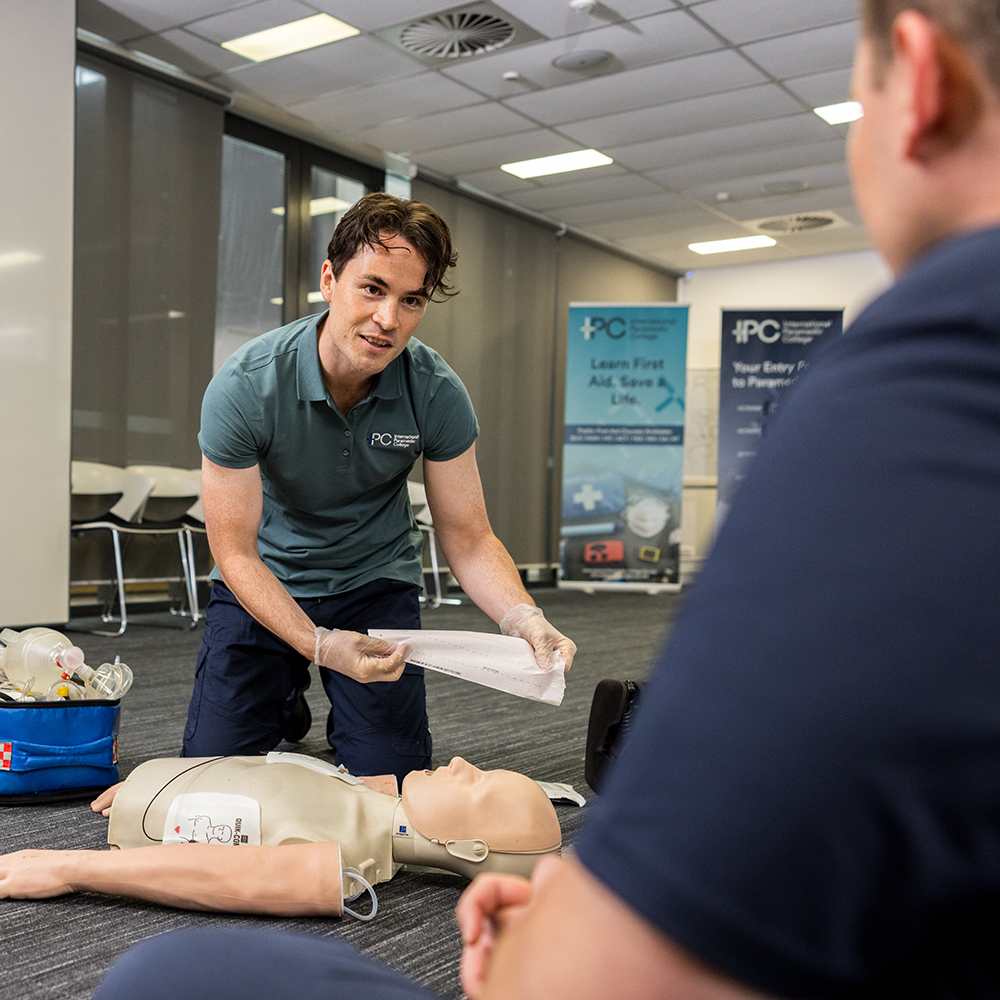
Choose your starting level
Pick the qualification level that suits your current confidence and experience so your learning feels achievable.
Build skills through structured training
Complete your learning at a steady pace, focusing on competence rather than rushing, so you’re well-prepared for the next step.
Progress to the next qualification stage
When you’re ready, move up to the next level in the paramedic training sequence with clearer direction and stronger foundations.
Roles that connect with this pathway
Non-emergency transport connects to plenty of other work in pre-hospital care. These roles take similar qualifications and people move between them regularly as they obtain different credentials:
FAQs
Below, we’ve answered common questions about becoming an ambulance transport attendant.
What qualification do you need to become an ambulance transport attendant?
A diploma-level qualification, most commonly the Diploma of Emergency Health Care. Registered Division 1 nurses and registered paramedics also qualify, though nurses need to complete a bridging course for non-emergency transport.
Is an ambulance transport attendant the same as a patient transport officer?
No. Attendants hold a higher qualification and can monitor patients at higher acuity levels. Patient transport officers hold a Certificate III and work with clinically stable patients.
How much do ambulance transport attendants earn?
Ambulance Victoria’s enterprise agreement sets the base at $1,323.50 a week, which is roughly $68,800 a year.
Can you become a paramedic through this role?
Not directly. Every paramedic role requires a paramedicine degree and registration with the Paramedicine Board. The experience as an ambulance transport attendant can help strengthen your application, but you’ll still need to complete a Bachelor of Paramedicine if you want to become a paramedic.
Why IPC is a smart place to begin
International Paramedic College supports your ambulance transport attendant pathway by keeping learning practical and helping you understand what to do next.


Training with real-world focus
Practical skill development and scenario thinking that's built for emergency-care readiness.

Clear progression support
We help you understand your next step in the paramedic training pathway.

Confidence-building structure
A guided learning model that keeps things achievable and goal-oriented.
Recognised training standards
When you’re working towards an ambulance transport attendant role, you want training that’s credible and consistent.
Registered Training Organisation (RTO 45284)
International Paramedic College is an ASQA-approved Registered Training Organisation (RTO 45284) that delivers nationally recognised training and qualifications in Australia.

Nationally recognised qualifications
We deliver nationally recognised qualifications and accredited training that support real employment and workplace outcomes.

Certification you can use anywhere
Upon completing training, your results lead to a recognised certification that can be used for employment, workplace compliance, and further study.

What our students say
Students often tell us the biggest difference is clarity. This includes knowing what to study first, what to build next, and how to stay motivated through the process.
“IPC made learning feel achievable. The trainers explained things clearly, the practical sessions were hands-on, and I finished the course feeling genuinely more confident.”

“I chose IPC because when I did research I found they had really good feedback from the students and students coming back to do more courses so I believe it’s the right school for me and the price was really good.”
“The structure was straightforward and the support was there when I needed it. Workshops were practical, and I always knew what I was working toward.”
“I wanted training that felt real. The scenarios, feedback and support helped me build skills I can actually apply, especially when things get stressful.”

“What stood out was how approachable the team is. They teach in a calm, practical way and make sure you understand the ‘why’, not just the steps.”

“I learned more than skills - I learned how to think clearly under pressure. The practical training and feedback helped me feel ready for real-world situations.”

Ready to plan your ambulance transport attendant pathway?
If you want help choosing the right starting point or mapping your next stage, our team can guide you through your options.
Our licences
Our qualification pathways for ambulance transport attendant work are built around nationally recognised training and industry-aligned standards.

Insights and guides
Explore these articles to learn more about ambulance transport attendant work, the qualifications behind it and how your study choices can shape your career.





Get help starting your healthcare journey
If you’re exploring entry-level healthcare training, our team can guide you through enrolment, study options, and what to expect from this course.
