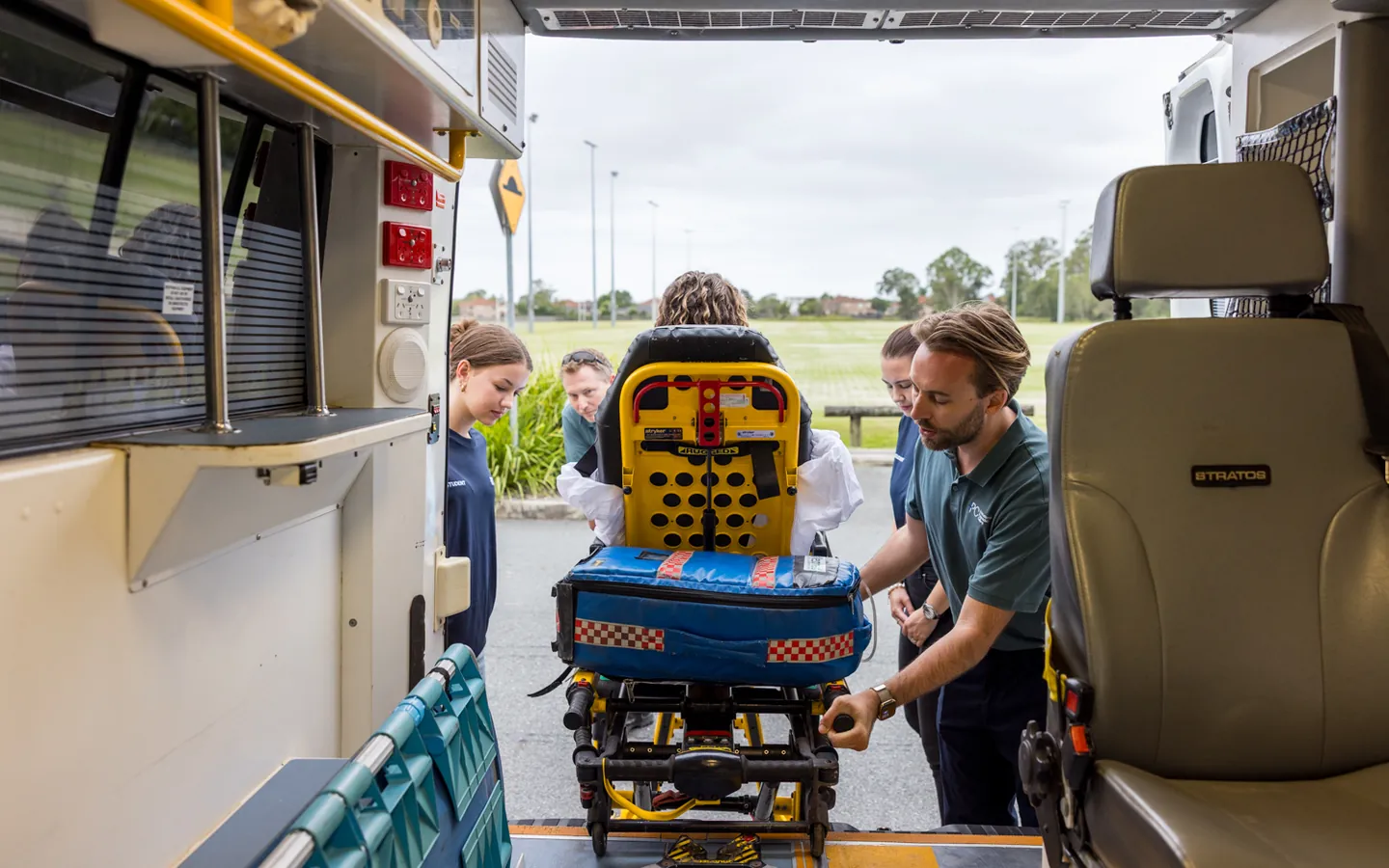
To become an ambulance paramedic in Australia, you’ll need an accredited paramedicine degree, registration with the Paramedicine Board, a clean driving history and a place in your state ambulance service’s graduate program. Each state service has its own version of the last two requirements, so a licence that could get you hired in Victoria might not be enough for Queensland.
What does an ambulance paramedic do?
Ambulance paramedics treat patients at the scene of an emergency, then keep treating them in the back of the vehicle on the way to hospital. According to NSW Ambulance’s recruitment guide, you’ll carry equipment weighing up to 24 kg and take loads of up to 60 kg when moving patients, often up and down stairs.
In addition to the physical labour, you’ll work a rotating 24-hour roster that includes nights and public holidays. You’ll routinely attend deaths and violent scenes working as an ambulance paramedic, including ones involving children, so it’s worth being honest about your willingness to do this part of the job before you think about becoming one.
Ambulance paramedic requirements
Each state sets its own ambulance paramedic requirements. NSW Ambulance publishes its full list in the Graduate Paramedic Intern Recruitment Guide, which makes it a useful example of what a service checks before it hires you. These figures come from the guide for the 2026 intake:
- Qualification and registration: You’ll need to be in your final year of an accredited paramedicine degree or have graduated within the last two years. AHPRA registration takes six to 12 weeks to process, so NSW Ambulance lets you apply while that’s still pending. You can’t start work until it comes through, though.
- Driver licence and driving history: You need an unrestricted licence to apply, though P2 licence holders can apply if they’ll be eligible for a full licence before an offer. You also need an unrestricted Light Rigid licence before you start. Your driving history can show no more than six demerit points in three years, three offences of the same kind in five years, six offences of any kind in ten years, one drink driving offence and one licence cancellation across your whole history.
- Background checks: You must be an Australian or New Zealand citizen or permanent resident, since NSW Ambulance doesn’t sponsor international applicants. The service also runs a national police check, requires a paid Working with Children Check, and may ask you to complete drug and alcohol screening. You’ll need evidence of immunity to diseases like hepatitis B, measles, pertussis and tuberculosis.
- Health assessment: An independent provider tests your vision, hearing, lung capacity, blood pressure and range of motion against the Paramedic Health Standard. The fitness component requires you to hold a plank for 60 seconds and to be able to carry two bags totalling 36 kg up and down a flight of stairs twice in under 90 seconds. You’ll also lift a 12 kg bag to shoulder height and carry it with one arm.
Before any of those checks, you’ll have to take an online psychometric test and have a video interview. Applicants who pass will join a merit list for 18 months, and NSW Ambulance will target them for induction classes from there.
How requirements differ between states
Outside NSW, the biggest differences are licence rules and when each service recruits:
- Ambulance Victoria: Victoria accepts a P2 licence you’ve held for at least a year and doesn’t require a Light Rigid licence. It also takes enquiries year round, so final-semester students can register their interest early.
- Queensland Ambulance Service: Queensland asks for a manual C class licence just to apply, so an automatic-only licence rules you out. You’ll need a Light Rigid licence before appointment. They recruit in scheduled campaigns once a year, usually in the middle of the year.
- St John WA: WA accepts applications from third-year students and asks for an unrestricted car licence with a good driving history. Its Paramedic Intern program lasts 18 months, which is longer than the 12-month graduate year most other services offer.
- SA Ambulance Service: South Australia asks for a full unrestricted car licence with no Light Rigid required. Successful applicants go into a recruitment pool that stays open for 12 months.
- ACT Ambulance Service: The ACT wants an unrestricted car licence plus a demerit transcript less than six months old. Its graduate program lasts 15 to 18 months, including study blocks.
- Ambulance Tasmania and St John NT: Neither publishes its licence requirements, so check the vacancy when a round opens. Tasmania screens candidates about a year before they start, while St John NT has four intakes a year.
What it costs to apply
You’ll have to pay for most of the checks yourself before any service hires you. That adds up to roughly $2,300 in costs to apply for ambulance paramedic positions before vaccinations and blood tests. NSW Ambulance lists these costs as of 2025:
- Light Rigid licence: Expect to pay $900 or more through Service NSW and a registered training organisation.
- Health assessment: The medical and fitness assessment starts from around $769, with the blood test charged separately by your pathology provider.
- AHPRA registration: The application fee is around $200, then you’ll pay about $300 a year to get registered.
- Working with Children Check: A paid check costs about $105 through Service NSW.
- Driving records: You’ll need a record from every state you’ve had a licence in, which starts from about $30 in NSW.
How long does it take to become an ambulance paramedic?
It takes about four years to become an ambulance paramedic in most states. The paramedicine degree alone takes three years full-time, then you’ll complete a supervised graduate year with your ambulance service before you work independently. In NSW, that year starts with a six-week induction followed by a 12-month transition to practice program. After a few years on road, you can apply to train as an intensive care paramedic or move into one of the other types of paramedic roles.
Start working in pre-hospital care with IPC
A degree is the only way to become an ambulance paramedic, though you don’t have to wait three years to start working in the field. The Certificate III in Non-Emergency Patient Transport qualifies you for patient transport jobs, while the Diploma of Emergency Health Care covers the event medical and industrial roles that fit around a university timetable. Talk to a course adviser about which one suits your plans.
Table of contents