



Becoming a paramedic is one of the most rewarding career choices you can make. It’s hands‑on, fast‑paced, and built around helping people on what may be the worst day of their lives.
This guide breaks down the steps to becoming a paramedic, the qualifications you need, and the different paramedic pathways available in Australia, all in a clear, practical way.
What is a paramedic?
Before diving into how to become one, it’s essential to understand what a paramedic actually does.
A paramedic is a trained healthcare professional who provides emergency medical care outside of a hospital setting. Paramedics respond to medical emergencies, accidents, trauma incidents, and urgent health situations, often working under pressure and in unpredictable environments.
What does it take to be a paramedic?
Paramedicine isn’t just about clinical skills. It also requires:
- Strong decision‑making under pressure
- Emotional resilience and compassion
- Physical capability and stamina
- Clear communication and teamwork
- A commitment to ongoing learning
How do you become a paramedic in Australia?
There isn’t one single route. There are multiple paramedic pathways, depending on your goals.
At a high level, becoming a paramedic in Australia usually involves:
- Completing recognised paramedic training
- Meeting paramedic entry requirements
- Gaining practical and clinical experience
- Applying for paramedic or first responder roles
Let’s walk through the steps in detail.

Industrial or mining sites
Step 1: Decide which paramedic pathway suits you
Not everyone starts in the same place when becoming a paramedic. Your background, career goals, and the type of work you want to do will influence which pathway is right for you.
Some people aim to work in frontline emergency care, while others are drawn to specialist or support roles across different industries.
You might be interested in working in:
- Industrial or mining sites, providing on-site emergency response and medical support
- Remote or offshore locations, where paramedics are often the primary healthcare providers
- Event medical services, supporting large public events, sports, and festivals
- Non-emergency patient transport, assisting with planned and low-acuity transfers
- First responder or emergency support roles in workplaces, communities, or volunteer settings
Understanding how to be a paramedic in Australia starts with knowing that these roles can require different levels of training and experience.
Common paramedic pathways include:
- Emergency Health Care qualifications – suited to those wanting broader emergency care skills and pre-hospital experience
- Non-Emergency Patient Transport (NEPT) – focused on patient care during planned transfers rather than emergency call-outs
- Medical First Response and first responder roles – ideal for workplaces, remote sites, or those starting their journey into emergency care
Choosing the right pathway early helps you select the most appropriate course, meet the correct paramedic requirements, and build experience that aligns with your long-term career goals.
Step 2: Meet paramedic prerequisites and entry requirements
Paramedic entry requirements are designed to make sure you can safely complete training, participate in practical workshops, and communicate effectively in real‑world emergency situations.
While requirements vary depending on the course and provider, common paramedic prerequisites usually include:
- Minimum age requirements – most qualification courses require you to be at least 18 years old at commencement
- Language, Literacy, Numeracy and digital skills (LLND) assessment – a short assessment used to identify the level of support you may need during your studies
- Physical capability – you must be able to safely perform practical skills such as CPR, patient handling, and equipment use during workshops
- Unique Student Identifier (USI) – required for all nationally recognised training in Australia
You may also be asked to provide basic identification documents and complete enrolment paperwork before starting your course.
Do you need previous medical experience?
Many students begin their journey into paramedicine with no previous medical or emergency services experience. IPC courses are designed to teach skills from the ground up, combining structured theory with hands‑on practical training.
If you already have experience in areas such as first aid, security, defence, community services, or workplace health and safety, this can be helpful, but it is not essential.
What matters most is your willingness to learn, your ability to engage with practical training, and your commitment to developing the skills required to work calmly and confidently in emergency situations.
Step 3: Complete the right paramedic qualifications
Formal training is essential. The qualifications needed to become a paramedic depend on the role you’re aiming for.
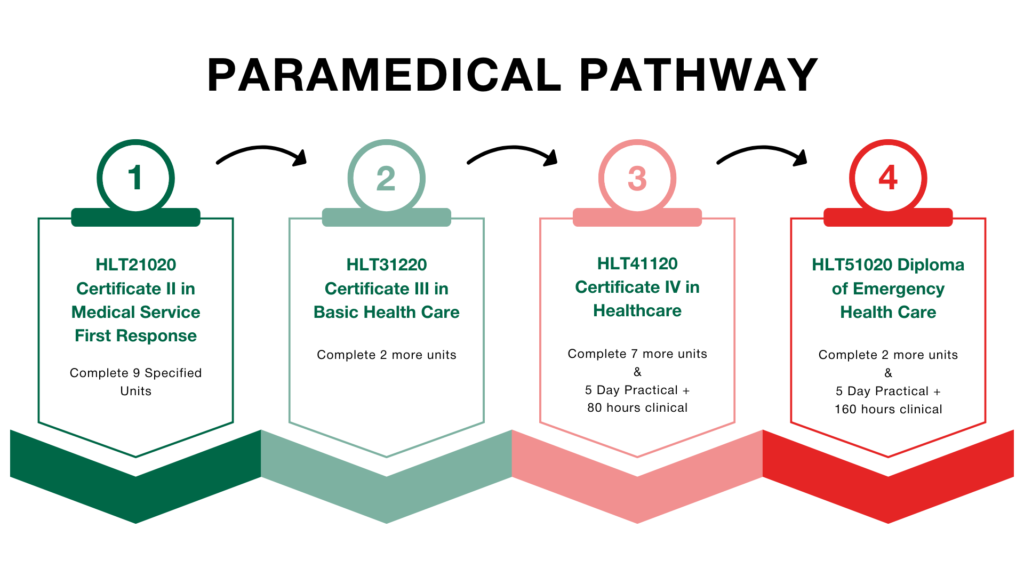
At International Paramedic College, nationally recognised courses to become a paramedic include:
| Qualification | Ideal For |
|---|---|
| Diploma of Emergency Health Care (HLT51020) | Advanced pre‑hospital and emergency roles |
| Certificate IV in Health Care (HLT41120) | Emergency health care and responder pathways |
| Certificate III in Basic Health Care (HLT31220) | Entry‑level health care support |
| Certificate III in Non‑Emergency Patient Transport (HLT31120) | NEPT roles |
| Certificate II in Medical Service First Response (HLT21020) | First responder and workplace response |
These qualifications form the foundation of paramedic training requirements and are recognised nationally.
Step 4: Complete practical training and placement
Learning how to be a paramedic isn’t just theory — practical experience is critical.
IPC’s training model includes:
- 100% online theory you can complete at your own pace
- A 5‑day intensive practical workshop led by experienced paramedics
- Clinical placement hours (varies by qualification)
This blended approach helps students build confidence and competence before stepping into real‑world roles.
Step 5: Apply to be a paramedic or first responder
Once qualified, the next step is to apply to become a paramedic or first responder.
Depending on your qualification, you may apply for roles such as:
- Emergency health care responder
- Industrial or mining medic
- NEPT officer
- Event medic
- Medical first responder
Can I be a paramedic without going to university?
Not exactly. To become a registered paramedic in Australia, you must complete an accredited Bachelor of Paramedicine (or equivalent) and be registered with the Paramedicine Board of Australia.
However, that doesn’t mean university is the only way to start a career in emergency health care.
Vocational education and training (VET) offers alternative pathways into paramedic-style roles, such as:
- Emergency medical technician (EMT)
- Event medic
- Patient transport officer
- Industrial or mine site medic
These roles allow you to build real-world experience in emergency response settings without a university degree.
IPC sits between university degrees and entry‑level training, offering:
- Practical, skills‑focused education
- Shorter timeframes than university
- Flexible online learning
- Clear pathways into employment
For many students, this provides a more accessible starting point and can also act as a stepping stone toward a future paramedicine degree if they choose to pursue full registration later.
Is becoming a paramedic right for you?
If you’ve been thinking about a career in paramedicine, the path is clearer than you might expect.
With the right training, support, and mindset, paramedicine offers a meaningful career where your skills truly matter.
At International Paramedic College, students are supported every step of the way, from choosing the right course to building confidence through practical training.
Ready to take the first step? Explore available paramedic courses today.
Table of contents