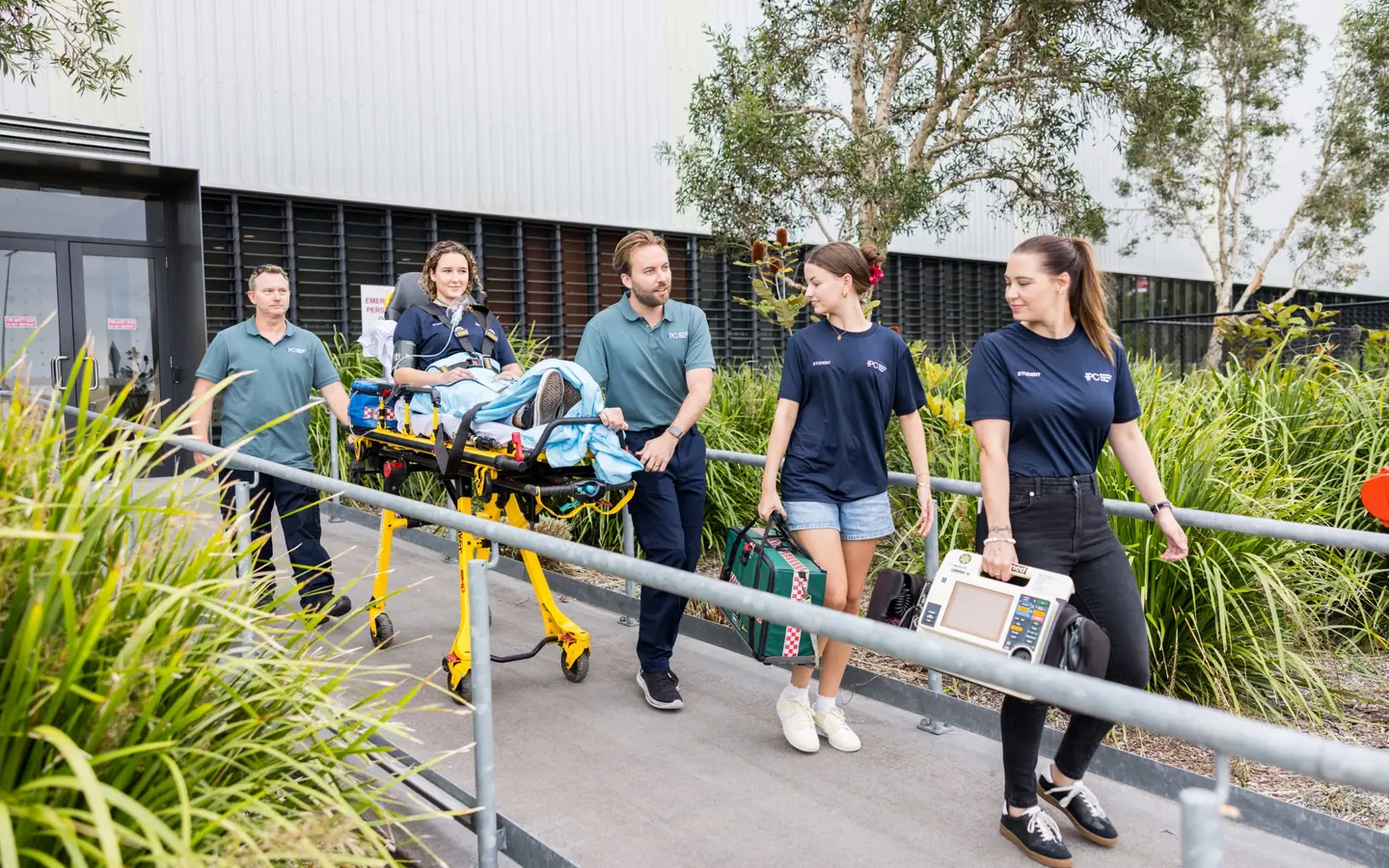
Australia has several different types of paramedics, with road ambulance work as the usual starting point. After several years on road, you can specialise in intensive care, extended care, flight or rescue work.
Plenty of other pre-hospital jobs look like similar work from the outside, though they don’t need the same training. Registration with the Paramedicine Board separates the two groups. Check which side of that line a role falls on and you’ll know whether it takes a university degree or a vocational qualification.
Why paramedic job titles vary between states
Each state and territory ambulance service sets its own classifications, so the same job may have a different name depending on where you work. A newly qualified paramedic is a Qualified Paramedic in NSW, an Advanced Life Support Paramedic in Victoria, an Advanced Care Paramedic in Queensland and simply a Paramedic in South Australia. Each service also sets its paramedics’ scope of practice, so they might have slightly different responsibilities.
The Australian Bureau of Statistics groups registered paramedics into two occupations. Paramedic covers the entry level, while Critical Care Paramedic covers the senior clinical tier, with flight and rescue paramedics listed as specialisations of it. This guide uses that split as its reference point, then names each state’s own titles where they matter.
Registered paramedic roles
You’ll need an accredited paramedicine degree and registration with the Paramedicine Board of Australia to work in any of the roles below. Paramedic is a protected title under national law, so nobody can use it without that registration. Each role starts from the same entry point, then branches into specialisations as you gain experience on road.
Ambulance paramedic
Ambulance paramedics respond to triple zero calls for a state ambulance service, working in two-person crews that treat patients on scene and on the way to hospital. It’s the entry point for every other registered role on this list.
Every service starts new graduates on a supervised program, though the name changes by state. NSW Ambulance and the ACT call these hires Graduate Paramedic Interns, while Ambulance Victoria calls them Graduate Ambulance Paramedics. Regardless of the title, you’ll spend 12 to 18 months under supervision before you can practise independently. You’ll need to meet each service’s ambulance paramedic requirements to get onto one of those programs.
Intensive care paramedic
Intensive care paramedics attend the most serious jobs. They can intubate a patient, give medication straight into the bone, manage complex trauma and treat serious heart conditions. Ambulance Victoria also trusts them to make those calls on scene without consulting a doctor first.
You might see them get called MICA paramedics, which is short for Mobile Intensive Care Ambulance, or Critical Care Paramedics. No matter the title, you must first work as a paramedic and then get selected by your service to train as an intensive care paramedic. At NSW Ambulance, you’ll train for 27 weeks before spending up to two years in a dedicated intensive care unit. Ambulance Victoria sets a longer route, asking for two years on road and a graduate diploma before you can start it. It takes around 10 years of study and experience in total to become an intensive care paramedic.
Extended care and community paramedic
Extended care paramedics treat patients at home who need care but not a trip to the emergency department. The work is closer to general practice than a lights-and-sirens job, which keeps emergency crews free for serious calls. NSW Ambulance trains them to prescribe medication and reduce dislocations on the spot.
NSW, South Australia, Tasmania and the ACT all use the title Extended Care Paramedic, while the Northern Territory calls the same role a Community Paramedic. Like intensive care work, this is a role you move into after time as a paramedic. NSW Ambulance puts selected paramedics through a 10-week program before they work as independent clinicians.
Flight and retrieval paramedic
Flight paramedics treat critically ill patients in the air, whether that’s a helicopter sent to a remote scene or a transfer between hospitals. NSW Ambulance crews its helicopters with critical care paramedics, and its Greater Sydney helicopter service flies more than 3,000 missions a year on its own.
Planes work differently in NSW. The state’s fixed-wing aircraft carry a pilot and a flight nurse with no paramedic onboard, so it’s nurses who handle that kind of work there. Outside the state services, CareFlight and the Royal Flying Doctor Service also hire paramedics for retrieval.
No service publishes a set entry requirement for flight roles. The Australian Bureau of Statistics classifies flight paramedics as a specialisation of critical care paramedic, which matches how NSW staffs helicopters, so plan on reaching intensive care level first. Paramedic salaries rise with each specialist classification, which puts flight roles toward the top end.
Rescue and special operations paramedic
Rescue paramedics help patients in places a regular crew can’t, like a crashed car or a collapsed building. NSW Ambulance has about 200 of them in its Special Operations Team, trained in road crash rescue, vertical rescue, swift water operations and land search and rescue. Their course also covers tactical medicine for responding to tactical incidents.
NSW Ambulance only considers paramedics with four years of experience for the team, then tests each applicant’s fitness and mechanical aptitude. Successful applicants then complete a two-month rescue course before starting the job.
Mine sites also advertise for rescue medics, though that’s a separate job. Those roles take a Certificate III in Mine Emergency Response and Rescue and don’t need paramedic registration.
Other specialist paramedic roles
NSW Ambulance’s recruitment guide lists a few more paths open to paramedics once they’ve spent some time on road:
- Snow operations: NSW Ambulance’s Alpine Operations team works out of Perisher Ambulance Station from the June long weekend to the October long weekend, then from Jindabyne for the rest of the year. You’d get to injured skiers by snowmobile or in a tracked snowcat fitted out as an ambulance.
- Rapid response: Rapid response paramedics travel alone to reach patients quickly. Arriving first lets them assess the scene and call for the right resources before a full crew gets there.
- Counter disaster: NSW Ambulance names counter disaster among its specialist areas. Paramedics in this field help plan for major emergencies and respond when one happens.
- Operations management: Paramedics who move into leadership can rise to Zone or Deputy Operations roles. These positions focus more on running the service across a region than on treating patients.
- Clinical instruction: Experienced paramedics can teach as clinical instructors or paramedic educators, training the paramedics coming up behind them.
Pre-hospital roles you can start without a degree
These roles use vocational qualifications from the HLT Health Training Package, ranging from a Certificate II up to a Diploma. You don’t need to be registered with the Paramedicine Board for any of them, as each employer sets its own requirements:
- Emergency medical technician: EMT isn’t a protected title in Australia, so there’s no licence or registration to get. Employers usually ask for a Certificate IV in Health Care and hire EMTs for private ambulance, event and industrial work. Our EMT vs paramedic guide compares the two roles in detail.
- Patient transport officer: A Certificate III in Non-Emergency Patient Transport qualifies you to move stable patients between hospitals and aged care homes. These patients are usually getting routine checkups done rather than dealing with an active health issue, so your job is mostly to monitor and help them get there safely.
- Ambulance transport attendant: You’ll work a level above patient transport officers, monitoring patients with more serious conditions on non-emergency trips. The title is mostly used in Victoria, where employers ask for a Diploma of Emergency Health Care.
- Event medic: You’ll staff the medical post at festivals and sporting fixtures, mostly on casual shifts. Event medical companies usually ask for a Certificate IV in Health Care.
- Mine and industrial medic: Mine sites pay more than any other employer in this group. Beyond a Certificate IV in Health Care, they expect a mine emergency response certificate and a heavy vehicle licence.
- First responder: Private employers pay first responders to cover events and industrial sites. State ambulance services also train community first responders in regional towns through the Certificate II in Medical Service First Response.
- Emergency services officer: You’ll lead fire, rescue and emergency response on industrial sites, with first aid as one part of the job. Employers typically ask for Advanced First Aid plus a Certificate III in Emergency Response and Rescue.
- Offshore medic: Offshore oil and gas work is similar to mine site medicine, though you’ll almost certainly need a full degree for it. NOPSEMA’s review of offshore facilities found that 52 of the 53 employing medics required a registered paramedic, nurse or doctor, though offshore medic jobs that don’t require a degree do exist.
Which pathway is right for you?
The first decision you have to make is whether you want to become a registered paramedic. If you do, start with a paramedicine degree. The specialist roles above come later, once you’ve spent several years on road. If you’d like to start working sooner, a vocational qualification can get you into pre-hospital care within months.
You can also do both. Plenty of students work in patient transport or event medicine while they complete their degree. That work won’t count towards registration, but it does give you clinical hours and a clear sense of whether the job suits you.
Pay can change quite a bit between tiers and states, so check how much paramedics earn before you commit to either route. If you’re still considering your paramedic career options, start by comparing each role and finding the course that matches it.
FAQs
What are the different types of paramedics in Australia?
Registered paramedics work as ambulance paramedics, intensive care paramedics, extended care paramedics, flight paramedics and rescue paramedics. Outside those registered roles, you’ll also find pre-hospital jobs like EMT, event medic and patient transport officer that don’t need a degree.
What is a MICA paramedic?
MICA stands for Mobile Intensive Care Ambulance. It’s Ambulance Victoria’s title for an intensive care paramedic, which Queensland calls a Critical Care Paramedic and other states call Intensive Care Paramedic.
What is the highest level of paramedic?
Intensive care paramedics hold the widest clinical scope on road. Flight and rescue paramedics are specialisations built on that level, and Ambulance Victoria estimates the path to its intensive care roles takes about ten years.
Can you become a paramedic without a degree?
No. Paramedic is a protected title, so you’ll need an accredited paramedicine degree and registration with the Paramedicine Board to use it. Roles like EMT and patient transport officer only need a vocational qualification.
What is a community paramedic?
A community paramedic treats patients at home who don’t need an emergency department. You’ll need to work as a registered paramedic first, then complete extra training through your ambulance service before you take on the role.
Table of contents